Category: Particle Physics
-

What’s the connection between spin and statistics – a simple argument
The Painted Ball Trick: Seeing the Connection Between Spin and Statistics Quantum mechanics is famous for being counter-intuitive. Two of its weirdest features are “spin” and the rules about how identical particles behave when you swap them. Spin isn’t really things spinning like tops, but it acts a bit like…
-

Why the Universe Isn’t Overflowing with Vacuum Energy: A Curious Field Theory Detour
Taming the Vacuum Energy: A Quantum Field Theory Twist on the Cosmological Constant Problem If you (or your friendly quantum field theorist friend) ever tried to calculate the energy of empty space using quantum field theory (QFT), you’ve both likely stumbled into a cosmic-sized embarrassment. The math predicts a vacuum…
-

Hawking radiation: a weight-loss program for black holes – another black hole conundrum and a cute connection between black holes and quantum field theory
Coming on the heels of the apparent success of Wegovy and Ozempic for obese humans, a situation that I am still very skeptical about for its long-term effects, I thought I would write a post about how Hawking radiation causes black holes to lose mass. It is subtle and not…
-
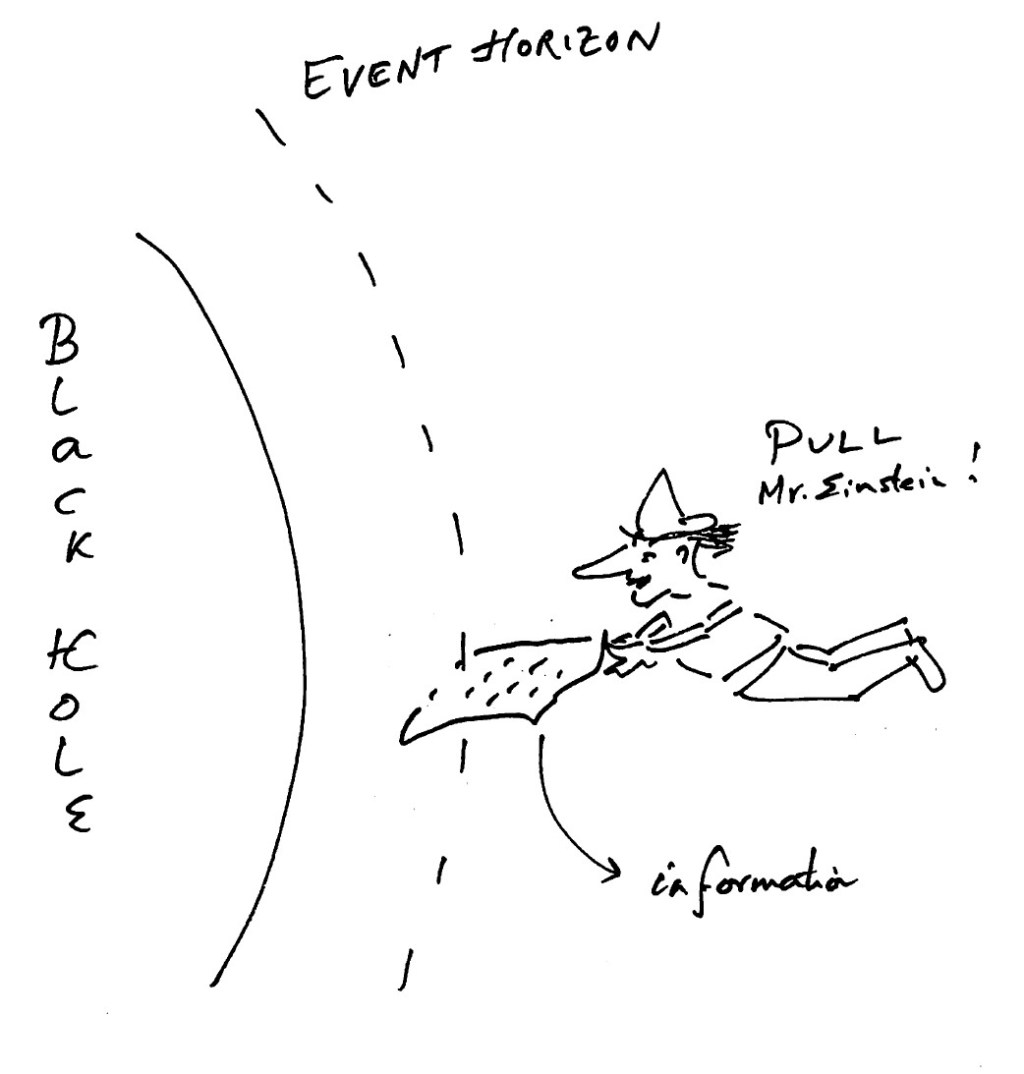
Black hole conundrums – how to extract information from a black hole
There is a problem that has been in the science news and blogged about a lot in recent years. It is called the Black Hole Information Paradox and essentially boils down to this. I throw some information into a black hole. It vanishes and can’t be retrieved. However, what does…
-

Unruh and Hawking – or how I get randomness from order, i.e., something ordered that looks random.
I have been planning to write a post about something rather esoteric, called the Unruh effect (and its intellectual descendant, the Hawking effect) and wanted to find a way to explain it to a high-school student. In the process, I discovered a new way to look at the effect, which…
-

Do we live in a hologram? How could we tell?
A neat way to show how we could tell experimentally that we live in a holographic universe
-

The universe in a grain of sand
This article attempts to explain a paper I wrote that is published in Europhysics Letters. The English engraver William Blake in a piece of poetry, the stories, the colossal orders of magnitude of sizes from the humongous to the very small make us wonder if somehow the very large is…
-
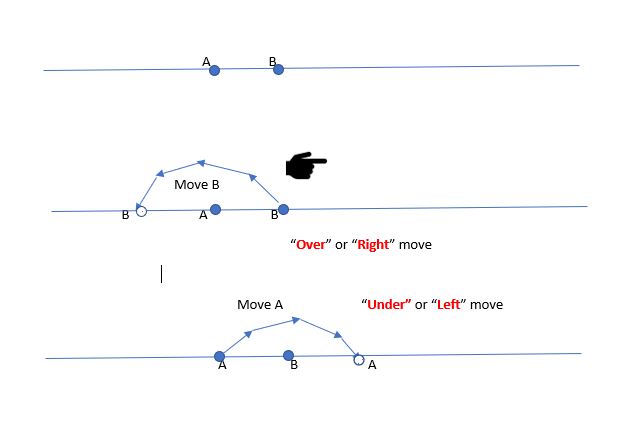
A story of commutators
The conceptual step that took humans from their pre-conceived “classical” notions of the world to the “quantum” notion was the realization that measurements don’t commute. This means, as an example, that if you measure the position of a particle exactly, you cannot simultaneously ascribe to it an infinitely precise momentum.…
-
Gauge invariance, Global and Local Symmetry
This post, aimed at people with some knowledge of Maxwell’s equations, is aimed at connecting a bunch of concepts that are all central to how we understand the universe today. Nearly every word in the title has the status of being a buzz-word, but for good reason – they help…
-
Binary/Ternary codes and card tricks
This trick uses the representation of numbers in a different base. Solution in a post in a day!
-

p-‘s and q-‘s redux
Continuing our saga, trying to be intellectually honest, while a little prurient (Look It Up!, to adopt a recent political slogan), let’s look at the ridiculous “measured” correlation in point 3 of this public post. Let’s call it the PPP-GDP correlation! The scatter graph with data is displayed below Does…
-

Minding your p-‘s and q-‘s
In the practice of statistical inference, the concept of p-value (as well as something that needs to exist, but doesn’t yet, called q-value), is very useful. So is a really important concept you need to understand if you want to fool people (or prevent yourself from being fooled!) – it’s…
-

Gedankenexperiments #1
Albert Einstein is well known to be one of the most creative scientists of the last couple of centuries. He produced fascinating theories that really burnished this reputation. But he also had several ideas (trying to undermine, for instance, ideas about quantum mechanics) that didn’t work – often the exact…
-
Can you travel faster through time?
If you watch science fiction movies, the most dramatic effects are obtained through some form of time travel. Pick some time in the future, or the past and a fabulous machine or spell swoops you away to that time. I have always had a problem with this simple approach to…
-

Coffee, anyon?
Based on the stats I receive from WordPress.com, most readers of this blog live in the US, India and the UK. In addition, there are several readers in Canada, Saudi Arabia, China, Romania, Turkey, Nigeria and France. Suppose you live in the first three of these countries. In addition, let’s…
-
The unreasonable importance of 1.74 seconds
1.74 seconds. If you know what I am talking about, you can discontinue reading this – its old news. If you don’t, its interesting what physicists can learn from 1.74 seconds. Its all buried in the story about GW170817. A few days ago, the people who constructed the LIGO telescope…
-

Mr. Einstein and my GPS
I promised to continue one of my previous posts and explain how Einstein’s theories of 1905 and 1915 together affect our GPS systems. If we hadn’t discovered relativity (special and general) by now, we’d have certainly discovered it by the odd behaviour of our clocks on the surface of the…
-

Special Relativity; Or how I learned to relax and love the Anti-Particle
The Special Theory of Relativity, which is the name for the set of ideas that Einstein proposed in 1905 in a paper titled “On the Electrodynamics of moving bodies”, starts with the premise that the Laws of Physics are the same for all observers that are traveling at uniform speeds…
 Simply Curious