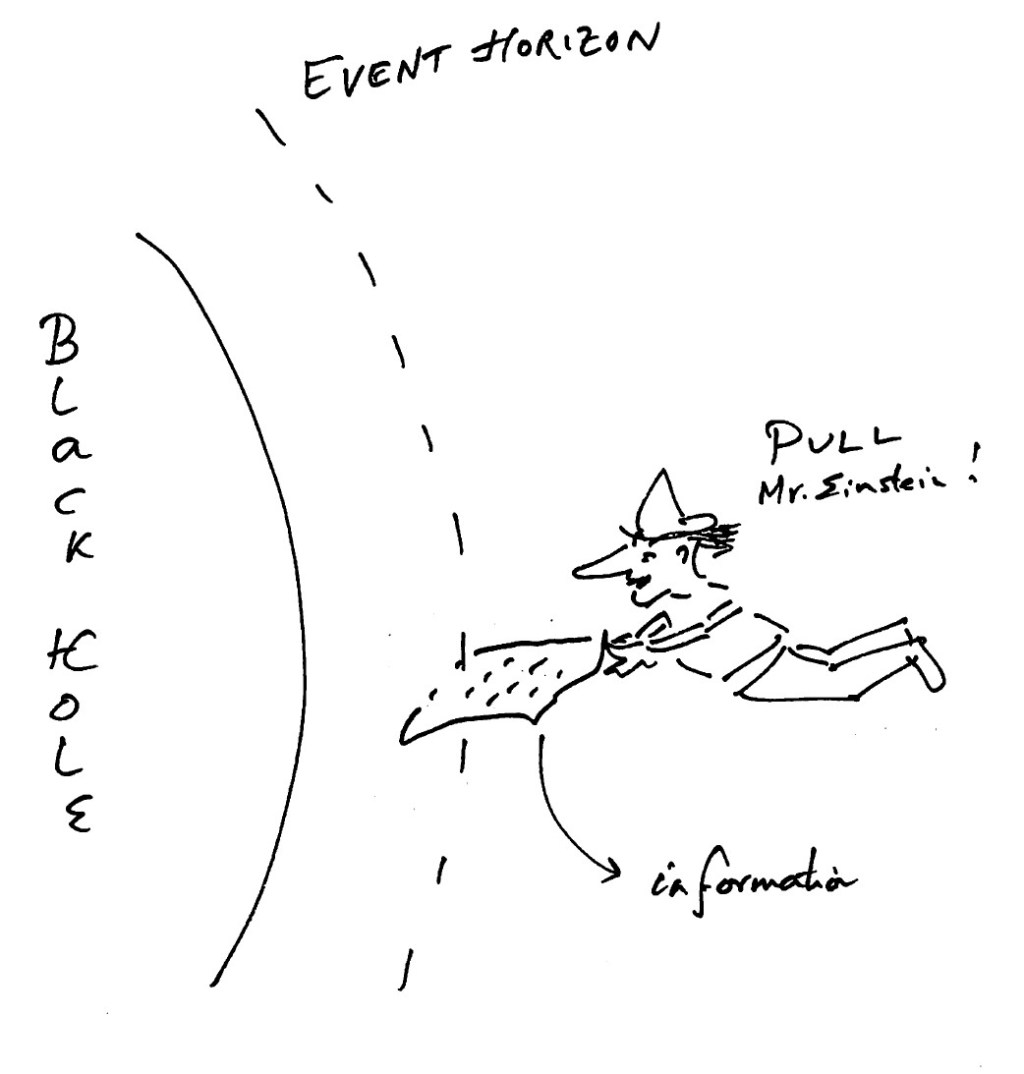
There is a problem that has been in the science news and blogged about a lot in recent years. It is called the Black Hole Information Paradox and essentially boils down to this.
I throw some information into a black hole. It vanishes and can’t be retrieved. However, what does come out of a black hole is Hawking radiation and it is “thermally” distributed – according to how a hot gas of photons would appear. Additionally, this means that the radiation contains no information – the information seems to have been lost forever, i.e., destroyed.
So what?
Information is a key ingredient in physical theories of the world. If I want to predict the future state of the universe, I need to have all the information possible to obtain about the current state. The equations of physics are time evolution equations – they tell you what the state becomes if you tell me what it starts from – completely.
There is a problem if some thing or action is able to destroy information – the equations of physics would suffer from not knowing the initial conditions as well as they should. The future of the universe would lose predictability. All of the effort expended in constructing physical theories would lose relevance – who cares about scientific theories if they cannot predict the future results of experiments. If I told you that 

Here is a useful conundrum to think about.
It is well known that time slows down for an observer sitting in a strong gravitational field. This is not just well-known to scientists but it plays a role in our GPS devices (see my post from a few years ago), which wouldn’t work properly if we didn’t correct for the general relativistic effect. While the observer sitting inside the gravitational field will notice nothing different, the observer floating infinitely far away would notice that the person in the gravitational field seems to be moving ever so slowly, as if they were immersed in a rather viscous fluid. In fact, in a black hole, as the far away observer sees an object falling into the black hole, as the object nears the event horizon, it seems to take interminable amounts of time (as measured by the far away observer) to get there. In fact, the far away observer will never see the object actually reach the event horizon, which is the sphere of no-return around a black hole.
Aha! There is a simple explanation for why information is never lost into a black hole. It never falls inside – even if a far away observer were to wait an infinite amount of time. OK, so it is a non-problem.
There is a flaw in the analysis I just made, though. It is worth reflecting on the issue before reading further.
A black hole is formed when enough matter is squeezed into a radius less than something called the Schwarzschild radius. Before the black hole is formed, of course, time will move slower near the surface of a massive star (as observed by a far away observer), but more stuff can fall in. Once the last atom needed for a particular Schwarzschild radius falls in, it collapses and shuts itself off forever. Now, as further objects fall into the region around the black hole, at some point, the slowly falling objects (for the outside, far away observer) will, collectively, be massive. The skin of matter around the black hole would become so massive that the black hole enlarges itself by the thickness of that skin. It is not so much that things fall into a black hole, but more that the black hole grows to swallow them! So, things will get eaten by a black hole in finite time, even though it would take an infinite amount of time before an object cleanly falls into a solitary classical black hole in empty space!
All right, so we do have an problem. People have thought of solutions. Many sorts of solutions. Some think that no one has tested general relativity at scales near where quantum effects should be important. This scale is usually referred to as the Planck scale and the length scale corresponding to it is 
Another is to observe that photons falling in from the outside are going to be extremely energetic as they fall in, so there is going to be a firewall at the boundary (the Event Horizon, or sphere of no return). That firewall might burn all the information up – doesn’t that mean the information is gone? Possibly then this information is stored in some hitherto unobserved phenomenon on the surface of the black hole.
There are a lot of conjectures about this.
I have a simpler solution, that I wrote a paper about, which just got published (a better text version is here). The key is a simple observation.
Hawking’s computation of the thermal radiation from a black hole starts from the premise that the black hole is surrounded by quantum fields in their vacuum state, i.e., with no free particles in it. In such a situation, there is indeed spontaneous particle-antiparticle creation near the Event Horizon where occasionally one of the pair falls into the black hole, while the other races off outside. This particle that we see outside is what we observe as Hawking radiation – the black hole isn’t black any more. If we assume that the black hole continues to be immersed in a quantum field in its vacuum state, then we can show that the distribution of the particles that races out is “thermal”, i.e., featureless, information-less and the Bose distribution.
There is a problem. In a quantum vacuum, there are NO free particles. The first such Hawking phenomenon just created a free particle in our universe, outside the black hole.
It is simple to see this in the context of an accelerated observer, which, if you read my previous post, is in a situation very similar to an observer in a gravitational field. There is also a horizon for such an accelerated observer and things appear to take an infinite amount of time in that accelerated observer’s frame to cross the horizon. Near such a horizon, if the inertial observer’s vacuum were to create, spontaneously, a pair of particles, one of those particles would, in the inertial observer’s frame, cross the horizon, while the other is “detected”, i.e., absorbed, by a photon detector carried by the accelerated observer. Then, one “free”, “unpaired” particle is left behind in the inertial observer’s reference frame.
As we see more particles created, the state of the inertial observer’s quantum fields surrounding the black hole is increasingly less and less the vacuum and more and more a state with many particles in it. When you follow the mathematics of the type of radiation that would be produced as the black hole is surrounded by this complicated state, it becomes evident that it is not the featureless, thermal radiation one associates with the Bose distribution. Instead, it has information in it. This information can be precisely used to reconstruct what the state of the entire quantum field is and one can tell what particles are in it and what went into the black hole.
So there: no paradox. I believe (I have heard this from some people) that the Stanford physicist Len Susskind talks about how one could reconstruct from the smoke particles surrounding a burning lump of coal exactly what sort of coal it was – just needs a lot of measurement apparata and lots of computational facilities. This problem appears to be one such.
 Simply Curious
Leave a comment